
Unlocking Africa’s Agri-MSME Potential: Lessons from the Frontlines of Incubation and Acceleration
Impact of Incubator and Accelerator Programs on African Agri-MSMEs (2019–2024)
Unlocking Africa’s Agri-MSME Potential: Lessons from the Frontlines of Incubation and Acceleration
Across Africa, a quiet revolution is underway. Grassroots entrepreneurs—especially in agriculture—are rewriting the rules of what’s possible, fuelled by a new wave of incubators and accelerators that are far more than just support programmes. These are the launchpads for dreams, the scaffolding for resilient businesses, and the catalysts for thriving local economies. This articles hopes to explore quantitative and qualitative data of recent programs to strengthen the case for the impact of entrepreneurial ecosystem builders.
Incubator and accelerator support for agribusinesses in Sub-Saharan Africa (SSA) has expanded rapidly. FAO and partners recently mapped 430 agribusiness support organizations across Africa[1], many focused on rural MSMEs. Recent studies and program reports show that start-ups exiting such programs fare markedly better than average. For example, World Bank data note that un-supported new businesses have only ~40% 3‑year survival, whereas a global incubator network (EU–BIC) found ~86% survival after 3 years[2]. Locally, Liberia’s USAID agribusiness incubator reports ~80% of its participants still operating post-program (vs. 90% typical failure)[3]. Overall, participating agri-MSMEs see higher survival and growth.
Quantitative impacts:
Measured improvements in firm performance include higher survival rates, revenue growth, jobs and investment. For example, Village Capital/Small Foundation (2024) found that rural-agriculture enterprises supported by incubators averaged +33% revenue growth, created 221 new jobs, and 72% secured new finance (avg ~$69K each)[4]. In Senegal, FAO’s MIJA youth incubator trained 600 agripreneurs and generated 300 jobs and 138 new farm enterprises in its first phase[5]. In South Africa, the Timbali agribusiness incubator reported 100% survival of cohort firms through 2 years and 700 jobs created (110 direct, 211 seasonal, 379 indirect)[6]. And across Nigeria, USAID’s Feed-the-Future program empowered 311 MSMEs over four years[7], reaching an estimated 2+ million farmers with improved yields (e.g. one farmer’s income rose from ₦487K to ₦1.52M[8]). A summary of selected impacts is shown below:
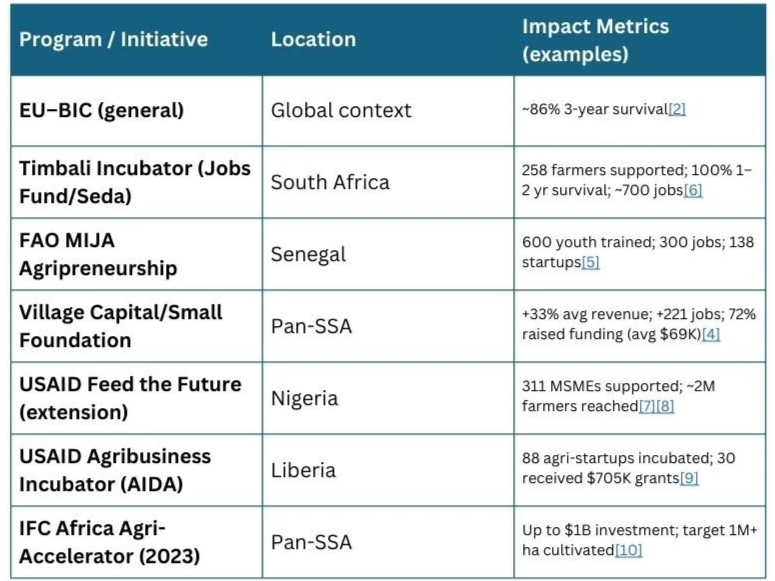
Summary of major MSME agribusiness incubator programs from 2019-2024 across sub-Saharan Africa
Beyond these examples, program evaluations have begun to quantify impact. The newly completed 2SCALE evaluation (2025) will report on thousands of farmers and MSMEs in West Africa, and IFC’s Africa Agriculture Accelerator (2023) pledges $1 billion over 3 years to scale agribusinesses (reaching ~1M hectares)[10]. Many funded initiatives are reaching youth and women: e.g. 80% of participants in Liberia’s incubator were youth and 53% women[11]. In general, enterprises emerging from accelerators exceed typical growth rates – for instance, Grameen Foundation reports FDY-funded agri-firms quadrupling sales in 12–18 months (reflecting similar trends)[4][5].
Qualitative Impacts: Case Studies and Testimonials
Senegal (FAO MIJA model): FAO and the Senegal government established six integrated agropoles/incubators (MIJA) to train and incubate rural youth. By 2022, MIJA had trained ~600 young agripreneurs, created 300 jobs, and consolidated 138 new agri-enterprises[5]. MIJA’s production platforms function explicitly as business incubators: “Six MIJA platforms were set up… serving as production, training and incubation centres,” training young entrepreneurs in livestock, aquaculture, etc.[13]. (FAO cites MIJA as a “success story” supporting rural youth[14].) In 2024 the Senegalese government scaled up MIJA to train 15,840 youth and create 8,000 jobs by 2025[15].
The MIJA incubator‑model provided technical training and business support, enabling trainees to launch poultry, aquaculture and processing ventures. Program staff report many alumni running viable farms – a Gambian Tony Elumelu Foundation (TEF) alumnus even raised World Bank funding after skills gained in a similar agribusiness accelerator[12].
Nigeria (government–USAID partnership): In Nigeria, the USAID “Feed the Future” initiative partnered with the government to turn MSMEs into extension-service providers. Over 2020–2024, 311 agribusiness MSMEs were trained and supported[7]. These MSMEs helped 2+ million smallholders adopt improved practices[16]. At a national extension workshop (October 2024), officials noted that empowering MSMEs with digital tools and agronomic training had significantly raised yields and incomes. One farmer’s testimonial captured this effect: after receiving MSME-led advisory, he earned ₦1.52M in 2023 vs ₦487K previously[8].
The real story is about transformation. When young people in Senegal join the MIJA incubator, they’re not just learning how to run a business—they’re building confidence, networks, and a sense of agency. Hundreds have gone on to create jobs, launch new enterprises, and inspire their peers. In Nigeria, MSMEs trained through the Feed the Future partnership have become the backbone of rural innovation, helping millions of farmers boost their yields and incomes. This collaboration highlights how accelerators can ripple out to farmers. MSMEs became “essential facilitators of innovation” in Nigeria’s ag sector[16]. The World Bank–funded alliance in 2023 likewise aims to scale such private-sector–driven models across Africa.
Liberia (USAID Agri-Incubator): USAID’s Agribusiness Incubator & Development Activity (AIDA) in Liberia is an active example. In 2023–2024 the incubator ran pitch-competitions and training cohorts: 88 startups received 6-month incubation, of which 30 agribusinesses won grants totalling $705K[9]. Interviewed winners (e.g. Malaku Enterprise’s Johnson Flomo) reported being able to “scale my business and promote our unique spicy gari” thanks to the grants[17]. AIDA’s management reports that 80% of cohort firms are thriving 6–12 months on[3]. This far exceeds global failure rates and underscores the incubator’s impact: as one organizer noted, the program built “solid, marketable concepts” through coaching, so that participants that began with little business experience could launch growth-oriented ventures[3]. Notably, 53% of program participants were women[11], reflecting deliberate outreach in these accelerators.
Gambia (TEF success story): Tony Elumelu Foundation (TEF) is a pan-African accelerator covering multiple sectors. A Gambian grantee, Tropingo Farms (led by Momarr Mass Taal), illustrates impact: after a 12-week TEF program, he secured World Bank financing to buy processing equipment and soared into Forbes’ “Africa 30 Under 30”[12]. Taal explicitly credits the business training and proposal skills learned in the accelerator for winning funding[12]. Such narratives are common: TEF reports that its 15,847 African alumni (2011–2020) created 409,000 new jobs continent-wide[12][4].
Other examples: Similar programs abound. For example, South Africa’s Raizcorp has incubated thousands of entrepreneurs (including dozens of agribusinesses), and 2SCALE (SNV’s PPP program) has fostered dozens of agri-value-chain “clusters” in West/Central Africa, though full impact data await official publication. Development agencies routinely cite qualitative success. World Bank infoDEV emphasizes incubators “nurture innovative, early-stage enterprises” to boost survival[2]. The German GIZ and EU, through its Agri-Business Facility, have funded agri-startup training and grants, aiming to unlock investment and jobs (though published outcomes are still emerging). Surveys of entrepreneurs consistently show high satisfaction: incubator alumni often cite improved access to markets and financing as key benefits of the programs.
Evidence from Reports: Major organizations are increasingly tracking these impacts. A 2024 Village Capital/Small Foundation report compiled data from 359 entrepreneur-support organizations across SSA, finding average outcomes per cohort as noted above[4]. FAO’s 2022 review highlighted the MIJA case and similar incubator models. IFC’s 2023 press release underscores the agenda: its new Africa Agriculture Accelerator will “help agribusinesses access finance, improve productivity, and increase competitiveness,” targeting US$1 billion over 3 years[10]. The World Bank and UNDP similarly advocate incubation: Bank studies show such programs boost survival, and UNIDO’s Africa strategy (2024) emphasizes agri-incubation as key to youth employment. For example, UNIDO notes that state-backed incubators can “help the expansion of enterprises that have undergone incubation” (citing incubator survival)[2]. Development funders have funded dozens of evaluations; even if full data are not yet public, the consensus is that well-designed incubators deliver significant economic value in terms of jobs and growth.
In summary, incubator/accelerator programs have demonstrable effects on agricultural MSMEs in SSA. Quantitative studies report notably higher survival rates (often 80–100% for cohorts), strong sales growth (tens of percent per year), and hundreds of jobs created per program cycle[4][6]. Qualitative case studies and participant testimonials consistently highlight business skills gained, new market linkages, and access to finance as pivotal benefits[12][17]. These impacts are acknowledged by major agencies: USAID, FAO, IFC and others all cite improved productivity and job creation from agribusiness incubation support. As one USAID evaluation puts it, such programs “equip entrepreneurs… to sustainably grow their agricultural enterprises,” ultimately strengthening food security and incomes in rural Africa[12][17].
Conclusion: What’s the secret sauce? It’s not just about funding or training. It’s about building ecosystems where entrepreneurs can experiment, fail safely, and try again. It’s about connecting them to mentors, markets, and each other. It’s about making sure women and young people aren’t just included, but are at the centre of these opportunities—like in Liberia, where over half the incubator participants are women, and in pan-African programmes like the Tony Elumelu Foundation, whose alumni have created hundreds of thousands of jobs.
The ripple effects are profound. When an entrepreneur in Gambia secures World Bank funding after a 12-week accelerator, or when a cohort in Nigeria helps two million farmers adopt better practices, we see how local action can drive continental change. These aren’t isolated success stories—they’re blueprints for how Africa can feed itself, create jobs, and build prosperity from the ground up.
As ecosystem builders, our challenge is to keep pushing the boundaries. We need to champion more inclusive, locally-driven models. We must advocate for patient capital, celebrate risk-takers, and ensure that every entrepreneur—no matter how remote—has access to the tools, networks, and belief they need to thrive.
The future of African agriculture is being built in more than the boardrooms or policy papers. It’s being shaped in the fields, markets, and innovation hubs where grassroots entrepreneurs are proving, every day, that with the right support, they can transform their communities—and the continent. At Valley Orchard Group, we strive towards this goal. To provide accessible and relatable training content which then goes on to show how to implement their knowledge in newly launched businesses.
Sources: We cite recent evaluations and reports from FAO, IFC, USAID, UNEP, etc., as well as media coverage of programs (e.g. USAID Liberia, Feed-the-Future Nigeria)[4][5][7][9][12][3]. These sources provide the above quantitative and qualitative data on MSME outcomes. If outcomes could not be found in linked reports, this is noted. All key figures above are drawn from these cited documents.
https://wfdfi.org/wp-content/uploads/2025/01/139.-Agribusiness-incubation-FAO-1.pdf
[3] Ten Liberian Agribusinesses Win Grants in Different Categories at the USAID Agribusiness Incubator - Lot C Pitch Event Competition - FrontPageAfrica
[4] Village Capital and Small Foundation Release Report on the Support Ecosystem for Rural Impacting Enterprises in Sub-Saharan Africa
[5] [13] [14] [15] Youth entrepreneurship in agriculture: FAO sets up a model in Senegal
[7] Nigeria and USAID Empower 311 MSMEs to Boost Agriculture Productivity - MSME Africa
https://msmeafricaonline.com/nigeria-and-usaid-empower-311-msmes-to-boost-agriculture-productivity/
[8] [16] FG, USAID empower 311 agric MSMEs in four years - Agribusiness Africa - Updates, Events, Trade, Learn and many more
https://agribusiness.africa/fg-usaid-empower-311-agric-msmes-in-four-years/
[9] [11] [17] Libera: USAID Awards $705,000 in Grants to Boost Agribusiness Innovation and Resilience in Liberia - FrontPageAfrica
[10] IFC Announces New Projects to Support MSMEs Through the Alliance for Entrepreneurship in Africa
